
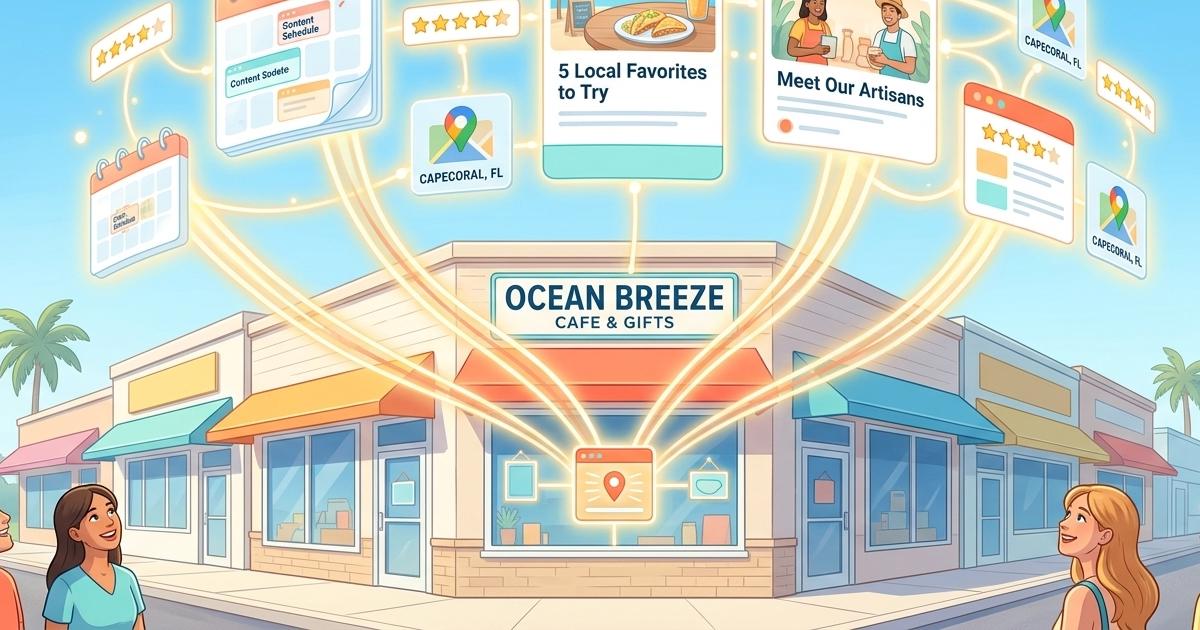

If you are a local business owner and your website does not have a blog, you are leaving one of the most powerful and cost effective marketing tools completely unused. Most business owners either think blogging is not relevant to their industry, do not know where to start, or assume it takes too much time to be worth it. All three of those assumptions are wrong — and by the end of this post you will understand exactly why a blog matters and exactly how to get one started without it taking over your life.
Why A Blog Matters For Local Businesses
Let us start with the most practical reason — Google. Every blog post you publish is a new page on your website. Every new page is another opportunity for Google to index your content and rank it in search results. A local plumber who writes a blog post about how to tell if your water heater needs replacing is now showing up when someone in their city searches for that exact question. That is a potential customer who found that business through a blog post rather than a paid ad.
This compounds over time. A business with fifty blog posts has fifty additional pages working for them in search results around the clock. A business with no blog has only its core pages — home, about, services, contact. Every competitor who is blogging consistently is building search authority that your static website simply cannot match.
Beyond search engines, a blog builds trust and credibility in a way that a services page never can. When a potential customer lands on your website and finds ten well written posts about topics relevant to your industry, they leave with the impression that you know what you are talking about. You have demonstrated expertise before they ever pick up the phone. That is enormously powerful in industries where trust is a prerequisite to getting hired.
A blog also gives you something to share on social media. Instead of scrambling to think of what to post, every new blog entry is a piece of content ready to go. Share it on Facebook, link to it on your Google Business Profile, send it to your email list. One piece of content becomes multiple touchpoints with your audience.
What A Local Business Should Blog About
This is the question that stops most people before they even start. What do I write about? The answer is simpler than you think — write about what your customers ask you.
Every question a customer has ever asked you is a blog post. Every problem you solve on a regular basis is a blog post. Every common mistake you see in your industry is a blog post. Every seasonal tip relevant to your service is a blog post. Every before and after project you complete is a blog post.
A landscaping company can write about the best grass types for Southwest Florida, when to fertilize your lawn, how to prepare your yard for hurricane season, and the most common lawn care mistakes homeowners make. A dental practice can write about the difference between a crown and a veneer, how to deal with dental anxiety, when to bring your child in for their first appointment, and what to expect during a root canal. A pool company can write about how often to test your pool water, the difference between chlorine and saltwater pools, and how to prepare your pool for summer.
You are already the expert. You already have the knowledge. A blog is simply the format for sharing it in a way that search engines can find and potential customers can benefit from.
How Often Should You Post
Consistency matters more than frequency. One well written blog post per week is far more effective than five posts one week and nothing for the next three months. Google pays attention to how consistently a website adds new content and rewards sites that maintain a regular publishing schedule.
For most local businesses one post per week is the sweet spot. It is enough to build search authority over time without becoming a second job. If one per week feels like too much to start, commit to twice a month and build from there. The worst thing you can do is start strong and burn out — consistency over intensity every time.
How Long Should Each Post Be
This is another question that causes people to overthink it. For local business blogs, posts between five hundred and twelve hundred words tend to perform well in search results. Long enough to cover a topic thoroughly, short enough that a busy person can actually read it. You do not need to write academic papers. Write the way you talk — clearly, directly, and without unnecessary padding.
That said, some topics warrant longer treatment. A comprehensive guide to something complex in your industry might run two thousand words or more and that is fine. Let the topic dictate the length, not an arbitrary word count target.
The Practical Steps To Getting Started
Step one is making sure your website has a blog section built in. If it does not, that is the first thing to address. Every website OrbiByte builds on Joe CMS includes full blog functionality built directly into the platform — no plugin required, no third party service to connect, just a clean integrated blog that is part of your site from day one.
Step two is making a list of ten topics before you write your first post. Having a backlog of ideas means you will never sit down to write with a blank mind. Use the question method — what do your customers ask you most often? Write those down. You now have your first ten posts.
Step three is writing your first post. Do not wait until it is perfect. Write it, read it once, fix any obvious errors, and publish it. A published imperfect post does infinitely more for your search presence than an unpublished perfect one sitting in your drafts.
Step four is submitting each post to Google Search Console after you publish it. This tells Google the page exists immediately rather than waiting for Google to find it on its own during its next crawl. It is a five second task that meaningfully speeds up how quickly your content gets indexed.
Step five is sharing each post. Put it on your Facebook page, add it to your Google Business Profile as an update, and if you have an email list send it there. Content that gets clicks and engagement builds authority faster than content that sits unread.
The Bottom Line
A blog is not just a feature for big companies with marketing departments. It is one of the most effective tools a local business has for building search visibility, demonstrating expertise, and attracting customers who are already looking for what you offer. The businesses in your market who are blogging consistently right now are building an advantage that will compound for years. The ones who are not are falling further behind with every week that passes.
Starting is the hardest part. After that it becomes a rhythm — and the results speak for themselves.
📞 (239) 471-9213 🌐 orbibyte.com/contact-us
