
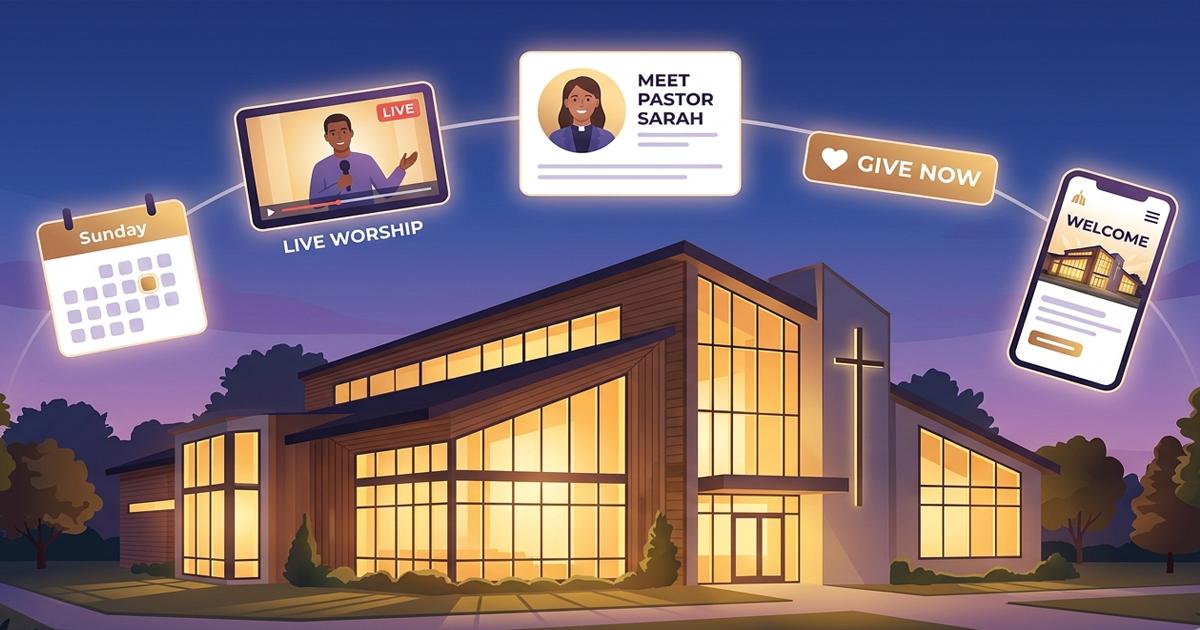

A church website is unlike any other business website. It is not primarily about selling a product or generating leads in the traditional sense. It is about welcoming people — people who may be searching for a spiritual home for the first time, people who are going through something difficult and looking for community, people who already belong to your congregation and need to stay connected. The stakes are genuinely high and the opportunity is significant.
Yet the majority of church websites fall short. They are outdated, hard to navigate on a phone, missing critical information, or so visually uninviting that a first time visitor clicks away before giving the congregation a real chance. This post covers exactly what a good church website needs — and how we approach building them at OrbiByte.
A Welcoming Home Page That Speaks To First Time Visitors
The home page of a church website has one primary job — making a first time visitor feel welcome enough to take the next step. That might be attending a service, watching a sermon online, reaching out to a staff member, or simply reading more about what the church believes and who it serves.
The home page should immediately communicate who you are, where you are, when services are held, and what kind of community someone can expect to find. It should feel warm and inviting, not institutional and cold. High quality photos of real congregation members — not stock photos — make an enormous difference. People want to see faces that look like theirs before they decide to walk through a door.
Staff And Leadership Pages
One of the most visited sections of any church website is the staff page. People want to know who the pastor is before they show up on Sunday. They want to see a photo, read a brief bio, understand the pastoral team's background and vision, and get a sense of the personality behind the pulpit.
A good staff page humanizes your leadership and builds trust before a first visit ever happens. Include photos, names, titles, a short personal bio for each staff member, and contact information or a contact form for each ministry leader. This is not just good web design — it is good hospitality.
A Calendar Of Events
A church is a living community and your website should reflect that. An up to date events calendar tells visitors and congregation members what is happening, when it is happening, and how to participate. Sunday services, Bible studies, youth group, outreach events, special services, holiday programs — all of it should be on the calendar and kept current.
An outdated events calendar with services from three months ago sends the wrong message entirely. It suggests nobody is minding the website — and by extension, potentially nobody is minding the church. A current active calendar signals a vibrant living community.
Online Giving And Donation Functionality
Tithing and giving have moved online for a significant portion of congregations, particularly younger members. A good church website makes online giving easy, secure, and clearly accessible from the home page. This is not about chasing money — it is about removing friction for members who want to give faithfully but do not always carry cash or a checkbook.
OrbiByte builds online giving and donation processing directly into the church websites we develop through Joe CMS, using secure payment gateway integration through Stripe. The giving process is simple, mobile friendly, and fully integrated into the site without requiring a third party giving platform that takes a percentage of every donation.
Sermon Archive And Blog
Sermons are content. Powerful, meaningful, searchable content that people look for online constantly. A church that archives its sermons — whether as audio files, video embeds, or written transcripts — is building a library of spiritual resources that serves both current members and potential visitors who found the church through a Google search.
The OrbiByte platform supports audio file integration with built in audio players, blog post functionality for written sermon content, and YouTube video embedding for video sermons. Each sermon post is indexed by Google, adding to the church's search presence week after week.
Live Streaming Integration
The pandemic permanently changed how congregations engage with church services. Many members — whether due to illness, distance, work schedules, or physical limitations — regularly worship online. A good church website makes live streaming easy to find and easy to access.
Whether your church streams through YouTube Live, Facebook Live, or a dedicated streaming platform, your website should have a clearly marked streaming page that activates during service times and provides easy access for online worshippers. This is no longer a nice to have — it is an expectation for a significant portion of modern congregations.
Multilingual Support
Churches serve communities and communities are diverse. In Southwest Florida in particular, a significant portion of the population speaks Spanish as a primary language. A church that serves a bilingual congregation needs a website that reflects that reality.
We recently built and maintain the website for Iglesia de Dios, a Spanish language church based in Fort Myers Florida. Their website at iglesiadediosfm1.org is built entirely on Joe CMS and serves their congregation in Spanish — from the home page through the services information, events calendar, and contact pages. Building a church website in a language other than English is not a technical obstacle with the right platform. It is simply a matter of content — and Joe CMS handles multilingual content natively without requiring additional plugins or platform upgrades.
A church that serves a bilingual community and only has an English website is leaving half its potential congregation without a welcoming front door. If your church ministers to Spanish speaking members, Haitian Creole speaking members, or any other language community, your website should speak their language too.
A Ministry And Small Groups Page
Beyond Sunday morning services, most churches have a rich ecosystem of ministries, small groups, outreach programs, and community initiatives. A good church website gives each of these a home — a page where people can learn what the ministry is about, who leads it, when it meets, and how to get involved.
This serves two purposes. It helps current members find and connect with the programs that serve their needs. And it shows potential visitors the depth and breadth of community life at your church — which is often what tips someone from curious visitor to committed member.
Contact Information And Location
This sounds obvious but you would be surprised how many church websites make it genuinely difficult to find an address, phone number, or service times. This information should be on every page of the website — in the footer at minimum — and should have its own dedicated contact page with an embedded map, complete address, phone number, email address, and a contact form.
If someone has to hunt for your church's address they will not hunt for long. They will go to the next result in Google.
Mobile Responsiveness Is Non-Negotiable
The majority of people searching for a church are doing it on their phone. They are in the car, they are new to the area, they are sitting with family on a Sunday morning looking for somewhere to go. If your church website does not work beautifully on a smartphone — if the text is tiny, the navigation is broken, or the service times are buried — you have lost that visitor before they ever arrived.
Every church website OrbiByte builds on Joe CMS is fully mobile responsive from the ground up. Not an afterthought, not a mobile plugin bolted on after the fact — mobile responsiveness built into every layout from the first line of code.
SEO For Churches
People search for churches online constantly — new residents looking for a church home, people going through life transitions who are returning to faith, families looking for youth programs, individuals searching for a specific denomination in their area. A church website that is properly optimized for search engines shows up for these searches. One that is not stays invisible.
Joe CMS includes built in SEO tools — clean URL structures, meta titles and descriptions for every page, schema markup for local businesses and organizations, XML sitemap generation, and Google Search Console integration. Every page we build for a church website is optimized to be found by the people who are already looking.
Why Joe CMS Is The Right Platform For Church Websites
Church websites have specific needs that generic platforms handle poorly. Online giving without excessive third party fees. Audio sermon integration. Multilingual content support. Event calendars that non-technical volunteers can update without breaking anything. A back end dashboard simple enough that a church administrator with no web experience can add a new staff member, post an event, or publish a sermon without calling a developer.
Joe CMS was built to handle all of this natively. The platform is stable, fast, and maintained by the same developer who built your site. There are no plugins to update, no WordPress vulnerabilities to patch, and no monthly fees to third party services eating into the church's budget. Just a clean professional website that serves your congregation and keeps working reliably month after month.
If your church is ready for a website that truly reflects the warmth, life, and community of your congregation — or if your current website is overdue for a serious upgrade — reach out and let us talk about what we can build for you.
📞 (239) 471-9213 🌐 orbibyte.com/contact-us
