
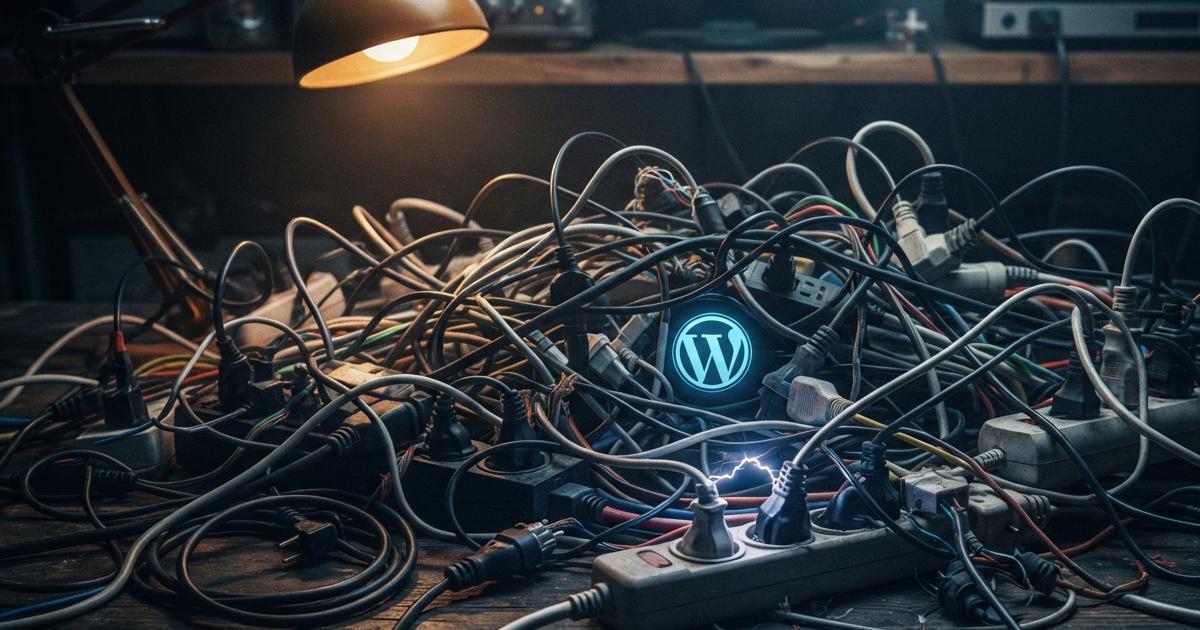

WordPress powers a significant portion of the internet, and that statistic is often repeated as if it were a badge of honor. But there is another way to look at it. A platform so widely adopted becomes a target. And when that platform's entire functionality depends on software written by thousands of strangers across the globe, the risks multiply in ways most business owners never fully understand until something goes wrong.
This is not about fear-mongering. This is about what is actually happening inside your website right now if it is built on WordPress and loaded with plugins — and why that matters more than most developers will ever tell you.
What WordPress Actually Is — And What It Is Not
WordPress began as a blogging platform. Over time it evolved into a content management system, and its open-source nature meant that developers around the world could build on top of it freely. That openness became its greatest strength and its most significant weakness.
Because WordPress itself does not do very much out of the box, nearly every meaningful feature on a WordPress website comes from a plugin. Want a contact form? Plugin. Want an SEO tool? Plugin. Want an ecommerce store, a booking system, a popup, a slider, a backup solution, a caching layer, a firewall, a social media feed? Plugin, plugin, plugin, plugin, plugin, plugin, plugin.
By the time a typical WordPress website is finished, it is not really a website. It is a patchwork of software from dozens of different developers, stitched together and hoped to work in harmony. And most of the time, it more or less does. Until it does not.
The Plugin Dependency Problem
Every plugin you install on a WordPress website is a dependency. That means your website's functionality is tied to a piece of software you did not write, do not control, and cannot fully audit. You are trusting that the developer who built it is keeping it updated, that they are responding to security vulnerabilities, that they are not abandoning the project, and that their code is written well enough not to conflict with the other dozen or more plugins sitting alongside it.
That is a lot of trust to place in people you have never met.
Why Third Party Plugins Create Real and Serious Risk
The plugin ecosystem that surrounds WordPress is enormous. The official WordPress plugin repository alone contains tens of thousands of options. Many of them are free. Many of them are built by solo developers working in their spare time. Many of them have not been updated in months or years. And many of them contain vulnerabilities that hackers actively search for and exploit.
This is not speculation. Security research firms publish reports every year documenting the volume of WordPress vulnerabilities discovered, and the overwhelming majority trace back to plugins. Not the WordPress core itself, but the third party software layered on top of it.
What a Vulnerable Plugin Actually Means for Your Business
When a plugin has a security vulnerability, it can mean different things depending on the severity. In some cases it means an attacker can inject malicious code into your website. In others it means they can gain administrative access, redirect your visitors to dangerous sites, steal customer data, or use your server to send spam. Your website can be blacklisted by Google before you even know anything has happened.
And the worst part is that many of these attacks are automated. Bots scan the web constantly, looking for websites running known vulnerable plugins. If your site matches, it gets targeted. It does not matter how small your business is or how little traffic you get. The bots do not care. They are looking for opportunity, not prominence.
The Update Treadmill and Why It Creates New Problems
The standard advice is to keep your plugins updated. That advice is correct, and it is also incomplete. Because every update is itself a potential source of new problems. An update to one plugin can break another. An update to WordPress core can cause a plugin to stop working entirely. A plugin developer can push an update that introduces a new vulnerability while fixing an old one.
Business owners who manage their own WordPress sites often find themselves stuck between two bad choices — update and risk breaking the site, or delay and remain exposed to known vulnerabilities. Neither option is comfortable. Neither option should be the reality for anyone trying to run a business.
The Broader Problem With Handing Your Business to a Third Party Ecosystem
Beyond security, there is a deeper issue with the way WordPress and its plugin ecosystem work. When you build a website on WordPress and rely on plugins for critical functionality, you are building your online business on a foundation that does not belong to you and is not designed specifically for your needs.
Consider what happens in any of the following scenarios:
- A plugin you depend on is abandoned by its developer and stops receiving updates
- A plugin you paid for stops being supported and the company shuts down
- A plugin conflict causes part of your site to break after a routine update
- A free plugin you have used for years suddenly goes premium and locks your data behind a paywall
- A malicious actor purchases an abandoned plugin and pushes an update containing malware to its existing user base
- A plugin update wipes out custom settings or configurations you spent hours getting right
- Two plugins perform overlapping functions and create unpredictable behavior on your site
Every single one of those scenarios is real and documented. They are not edge cases. They are the kinds of things that happen to WordPress websites every single day.
The False Economy of Free Plugins
There is a reason so many WordPress plugins are free. In some cases the developer is genuinely generous and committed to the open-source community. But in many cases, free plugins are a loss leader. The goal is to get you dependent on the plugin and then offer a premium version with the features you actually need. Or to sell advertising inside the plugin interface. Or, in darker scenarios, to collect data from the websites where it is installed.
Free does not mean safe. Free does not mean maintained. And free certainly does not mean that someone is watching over that code and making sure it does not put your business at risk.
What You Are Really Paying For When You Pay for Plugins
Premium plugins are not necessarily safer. They introduce their own complications. When you pay for a plugin, you are often licensing it on a subscription basis. Stop paying and you may lose access to updates, which means you are back to running outdated software. You are also dependent on that company staying in business, maintaining their product, and continuing to support the version of WordPress you are running.
When you add up all the premium plugins a fully functional WordPress site might need — security tools, form builders, ecommerce platforms, SEO plugins, backup solutions, performance tools — the cost is not trivial. And none of it is building equity in a platform you actually own.
There Is a Better Way to Build a Website
The alternative to the WordPress plugin economy is not necessarily simpler, but it is fundamentally more stable and more secure. A website built on a custom platform by a developer who controls the codebase means that every feature was intentionally built for your specific needs. There are no unnecessary plugins sitting dormant in your database. There are no third parties with access to your site. There are no conflicting software systems trying to coexist inside the same environment.
When a developer builds your platform from the ground up, they own the code, they understand the code, and they can update, modify, and secure it without waiting for a third party to release a patch. When something breaks, there is one person responsible. When something needs to change, there is no compatibility matrix to navigate.
That is not a luxury. That is how a serious business website should be built.
The plugin economy that WordPress depends on is not going away. Millions of websites will continue to run on it. But understanding what that really means — the exposure, the dependencies, the fragility, and the lack of control — is the first step toward making a smarter decision about where you build your business online. And that decision is one of the most important ones you will ever make.
